
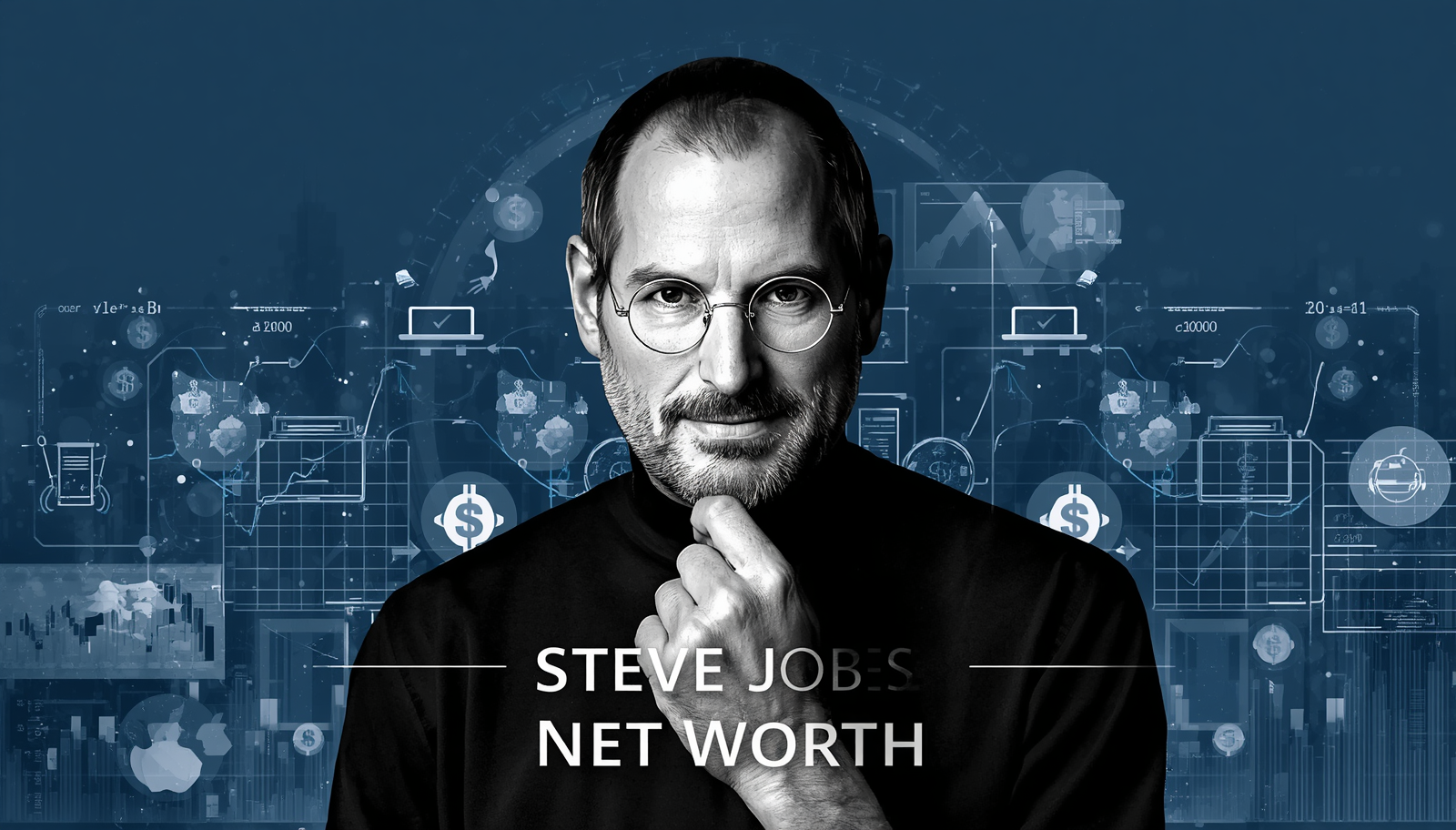
If you grew up watching Steve Jobs walk on stage in that black turtleneck, you probably assume his fortune came from Apple. It didn’t – not most of it, anyway. When Jobs died in October 2011, only about $2 billion of his estimated $10.2 billion net worth was Apple stock. The rest came from a company most people don’t even associate with him: Disney.
That twist is the key to understanding his entire financial story, and it’s also why you’ll find different numbers floating around depending on which site you check. Let’s sort out what’s actually true.
How Much Was Steve Jobs Worth When He Died?
Steve Jobs died on October 5, 2011, with an estimated net worth of $10.2 billion, according to Forbes’ contemporaneous estimate. Of that, roughly $2 billion sat in Apple shares – about 5.5 million of them, a stake built from the generous stock package Apple’s board offered him when he returned as CEO in 1997. The remaining $8 billion-plus came from Disney stock, which he received when Disney bought Pixar in 2006.
That’s the headline number, and it’s the one most commonly cited. But if you go searching, you’ll also see $8.3 billion and $7 billion attached to his name. None of those figures are “wrong” – they’re just measuring different things at different times, which is worth understanding before you take any single number at face value.
Why Do Net Worth Estimates for Steve Jobs Vary So Much?
Here’s something most articles gloss over: Steve Jobs has been dead for over a decade. There’s no “current” net worth for a person who isn’t alive to hold or grow assets. So when you see a 2026 estimate, what you’re really looking at is one of three things:
The 2011 death-date snapshot ($10.2B). This is Forbes’ estimate at the moment he died, based on his actual Apple and Disney holdings at the time. It’s the most historically accurate figure because it’s tied to real, documented shares.
A retrospective or re-calculated estimate ($8.3B). Some outlets recalculate using slightly different share counts, timing, or stock price assumptions, which produces a lower figure. This isn’t fraud – it’s just a different accounting snapshot, often published years later using archived data.
A “posthumous” Forbes tracking figure ($7B). Confusingly, Forbes still lists Jobs on some of its rich lists with an estimate that’s meant to represent what his original estate might be worth if untouched – but this doesn’t account for the fact that his widow, Laurene Powell Jobs, has since sold off large chunks of the Disney stake and redistributed the wealth. It’s an approximation of a moving target, not a real, current sum.
The honest takeaway: if you want the number that best represents “what Steve Jobs was actually worth,” use the $10.2 billion 2011 death-date figure. Everything after that is really a story about his estate, not about him.
Steve Jobs’ Wealth Timeline: From Garage Startup to Billionaire
The fastest way to understand how Jobs got rich is to watch the money move year by year. It’s a much stranger path than “founded Apple, got rich.”
| Year | Event | Financial Impact |
|---|---|---|
| 1976 | Co-founds Apple with Steve Wozniak in his parents’ garage | $0 |
| 1978 | Apple valued highly enough that his stake tops $1 million | ~$1M |
| 1980 | Apple’s IPO | Jobs’ 15% stake worth roughly $217 million |
| 1985 | Forced out by Apple’s board after a power struggle | Sells 99.999% of his Apple stock for ~$100M, keeps a single share |
| 1986 | Buys Lucasfilm’s computer graphics division for $10 million, renames it Pixar | Years of losses before any payoff |
| 1995 | Pixar goes public after Toy Story‘s success | Jobs owns ~80% of Pixar — officially a billionaire |
| 1997 | Returns to Apple as CEO, takes a $1 salary but a large equity package | 5.5 million Apple shares |
| 2006 | Disney acquires Pixar for $7.4 billion | Jobs becomes Disney’s largest individual shareholder |
| 2011 | Dies at 56 | Net worth: $10.2 billion — about 80% of it Disney stock |
Look at that table closely and the real story jumps out: Apple made him a millionaire twice, but it was Pixar, a company he almost gave up on and personally funded to the tune of $50 million during its rocky early years, that made him a billionaire. If Pixar had folded – and it nearly did in the early ’90s – Jobs’ financial legacy looks completely different.
It’s also worth sitting with this: despite being arguably the most culturally influential businessman of his generation, Steve Jobs never cracked the top 20 on any global rich list, even at his wealthiest. He was influential, not ultra-wealthy by billionaire standards – a distinction that gets lost in the mythology.
What Would Steve Jobs Be Worth Today If He’d Kept His Apple Shares?
This is the “what if” that makes people’s jaws drop, so let’s run the numbers honestly.
When Jobs was forced out of Apple in 1985, he sold nearly all of his 15% stake – about 7.5 million shares at the time – for roughly $100 million. Reasonable money in 1985. But Apple has since split its stock multiple times (7-for-1 in 2014, 4-for-1 in 2020), and the company’s value has grown from a struggling computer maker into a $3-trillion-plus tech giant.
If Jobs had simply held onto that original stake and never sold a share, accounting for the splits, he’d own roughly 78.9 million shares today. At Apple’s current valuation, that position would be worth somewhere in the $400–465 billion range – enough to make him, by a wide margin, the single richest person on the planet, more than double whoever currently holds that title.
That’s the cost of one boardroom fight in 1985. It’s also a useful reminder that Jobs’ actual fortune – the real, documented $10.2 billion – came almost entirely from decisions made after he left Apple, not from the company most people associate him with.
How Steve Jobs Built His Fortune
Strip away the biography and look purely at the money-making decisions, and Jobs’ career breaks into four distinct chapters.
Chapter one: the Apple founding (1976–1985). Jobs and Wozniak built the Apple I and Apple II out of a garage, and by the 1980 IPO, Jobs’ 15% stake was worth $217 million. This is the “classic” version of the story everyone knows.
Chapter two: the wilderness years (1985–1996). After being pushed out, Jobs founded NeXT, a computer company that never became a commercial hit but whose operating system Apple would eventually buy back for $429 million – the deal that brought Jobs back into the fold. During this same stretch, he bought Pixar and nearly lost his shirt on it before Toy Story changed everything in 1995.
Chapter three: the second act at Apple (1997–2011). Jobs returned as CEO for a symbolic $1 annual salary – a well-known fact that’s often repeated without explanation. The real compensation wasn’t the salary; it was the stock. Apple’s board handed him a substantial equity package specifically because they wanted his incentives tied to the company’s stock price, not a paycheck. It worked: under his leadership, Apple launched the iMac, iPod, iTunes, iPhone, and iPad, and became the most valuable company in the world.
Chapter four: the Disney windfall (2006–2011). When Disney bought Pixar, Jobs took his payment in Disney stock rather than cash – a decision that, in hindsight, built the majority of his eventual fortune. By the time he died, that Disney stake dwarfed his Apple holdings.
How Does Steve Jobs Compare to Other Tech Billionaires?
Here’s where Jobs’ story gets genuinely surprising: for someone this famous, he wasn’t actually that rich by tech-billionaire standards.
| Person | Peak/Death Net Worth | Primary Source |
|---|---|---|
| Steve Jobs | $10.2B (at death, 2011) | Disney stock (Pixar sale) + Apple equity |
| Bill Gates | $100B+ (peak) | Microsoft stock held over decades |
| Larry Ellison | $150B+ (2020s) | Oracle stock held over decades |
| Steve Wozniak | Estimated in the low hundreds of millions | Early Apple stake, sold most of it in the ’80s |
| Jeff Bezos | $150B+ (2020s) | Amazon stock held over decades |
The pattern is obvious once you see it laid out: Gates, Ellison, and Bezos all built vastly larger fortunes than Jobs primarily because they held onto their founding stock for decades. Jobs sold his original Apple stake in 1985 and had to rebuild his wealth from scratch through Pixar and a second, smaller Apple equity package. His fame outpaced his fortune – which is a genuinely unusual position for a business figure of his stature.
Who Inherited Steve Jobs’ Fortune?
Jobs had four children, but only two people directly inherited significant assets.
Laurene Powell Jobs, his wife of 20 years, received the overwhelming majority of the estate – primarily the Disney and Apple holdings. As of early 2026, Forbes estimates her personal net worth at roughly $13.6 billion, built partly on the original inheritance and partly on her own moves since: she founded the Emerson Collective, which funds environmental and education initiatives, acquired a major stake in The Atlantic, and holds ownership in Monumental Sports (the Washington Wizards, Capitals, and Mystics). In 2017 she sold roughly half of the couple’s original Disney stake – about 64 million shares – for around $7 billion, which tells you how much that single Pixar-for-Disney-stock decision back in 2006 was ultimately worth.
Lisa Brennan-Jobs, his eldest daughter from a relationship with high-school girlfriend Chrisann Brennan, received a reported $25 million inheritance. Their relationship was famously strained early on – Jobs initially denied paternity – but the two reconciled, and she took his surname in 1986.
Jobs’ other three children, from his marriage to Powell Jobs, were not reported to receive major direct inheritances of the same scale, since most of the estate passed to Laurene as his surviving spouse.
Frequently Asked Questions (FAQS) About Steve Jobs’ Net Worth
What was Steve Jobs’ net worth when he died?
Approximately $10.2 billion, according to Forbes’ 2011 estimate – about $2 billion in Apple stock and $8 billion-plus in Disney stock.
Was Steve Jobs ever the richest man in the world?
No. Even at his peak, he never ranked in the top 20 globally. His fame vastly outpaced his actual net worth compared to peers like Bill Gates or Larry Ellison.
Did Steve Jobs give money to charity?
He kept his philanthropic activity, if any, largely private during his lifetime – a notable contrast to contemporaries like Bill Gates, who built a public philanthropic brand. Most large-scale giving associated with the Jobs name has come after his death, through Laurene Powell Jobs’ Emerson Collective.
How much of his fortune came from Apple vs. Disney?
At the time of his death, roughly 80% of his net worth was Disney stock (from the Pixar sale), and only about 20% was Apple stock.
What happened to his Apple stock after his death?
It passed to Laurene Powell Jobs along with the rest of his estate. Apple has since split its stock twice more (2014 and 2020), significantly multiplying the share count and value of any holdings that remained.
Who owns Steve Jobs’ shares now?
Primarily Laurene Powell Jobs, though she has sold portions of both the Disney and Apple stakes over the years to fund her philanthropic and investment activities.

1 Comment
Pingback: Travis Kelce and Taylor Swift: Their Complete Relationship Story, From First Date to Wedding - The True Magazine